Most commercial roof leaks can be fixed with a targeted repair, as long as the structure underneath is sound and the problem is caught early. The way to get there is a documented inspection by a licensed, insured roofer who tells you honestly whether you need a patch, a larger repair or a replacement. That is how we work at RC Roofing and Contracting, a family-owned roofing company in Washington, MO. We offer free inspections and honest advice on repair versus replacement for businesses and property managers in Franklin County and the St. Louis area.
This guide covers what to look for, how a repair is carried out, when repair stops making sense, what to check before you hire, and how to avoid paying for the same leak twice.
TL;DR
- Small, localized problems such as open seams, damaged flashing, punctures and clogged drains are usually repairable. Widespread wet insulation or a damaged deck points toward replacement.
- Ponding water, stains on ceilings, mold or plant growth, and loose or missing pieces after hail or wind all call for a professional look.
- Have the roof inspected at least once a year, ideally in spring and fall, and again after severe weather. Keep the reports.
- Before hiring, verify the license or bond, liability and workers’ compensation coverage, references, and a written scope with line-item pricing.
- We inspect commercial roofs in Washington, MO and Franklin County for free and back our work with a lifetime workmanship warranty.
Table of Contents
- Signs your commercial roof needs repair
- What the repair depends on: your roof system
- How a commercial roof repair works, step by step
- Repair or replace: how the decision is made
- What affects the price of a commercial roof repair
- How to choose a commercial roof repair service
- Preventing the next repair: inspections and maintenance
- Commercial roof repair with RC Roofing and Contracting
- FAQ
- Sources
Signs your commercial roof needs repair
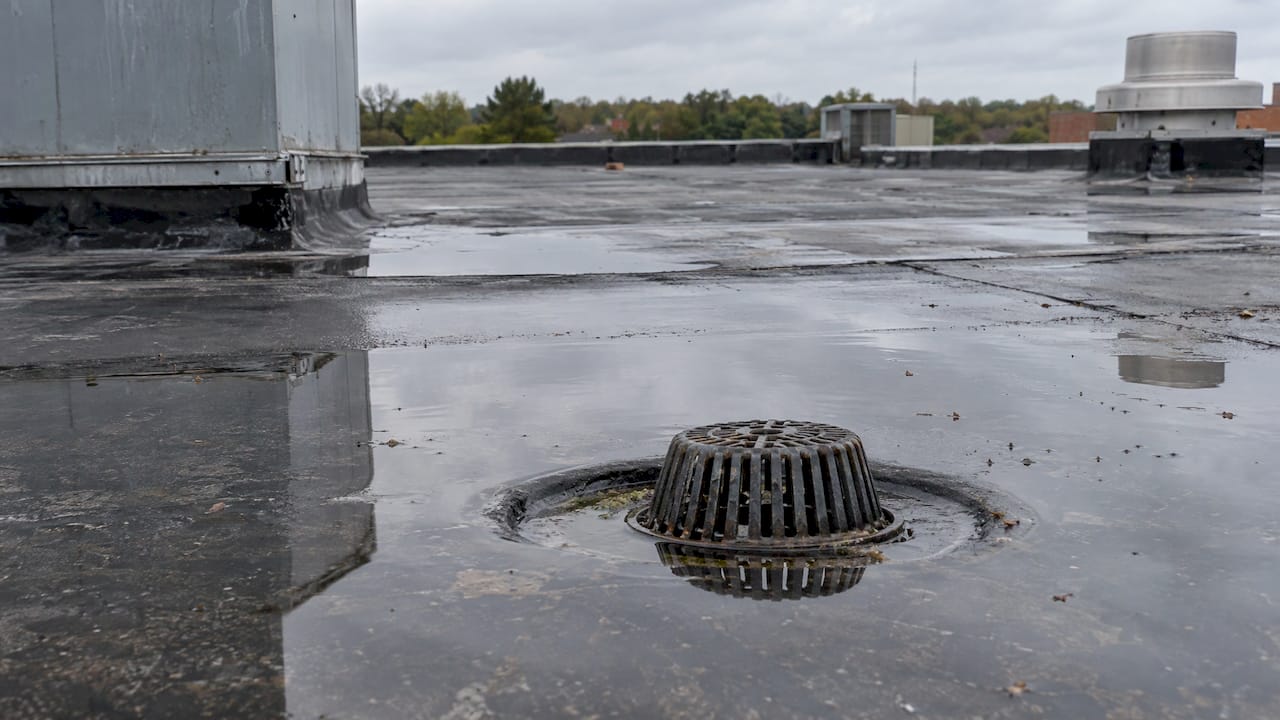
The obvious sign is a stain or drip inside the building. But the roof usually shows trouble first. The Insurance Institute for Catastrophic Loss Reduction (ICLR) names long-term ponding, mold or vegetation growth, and visible water damage below the roof as warning signs that need investigation. Its inspection guidance covers both the roof surface and the underside of the roof or drop ceiling, so check ceiling tiles as well as the membrane.
An insurance industry guide to commercial roof inspection adds a longer list of conditions that justify a professional evaluation:
- clogged drains
- bubbling or cracking surfacing
- recurring ponding
- damaged flashing (the metal or membrane that seals joints and edges)
- leaks around skylights or pipes
- loose or missing components after hail or wind
When a leak is an emergency
Treat it as urgent when water is entering occupied space, reaching electrical equipment, wetting inventory or stock, or soaking ceilings that could fail. Move people and goods out of the way, protect equipment, and call a roofer the same day. After a storm, a temporary cover can hold until the permanent fix; our guide to what works and what doesn’t in temporary storm roof repair explains how to buy time without making the repair harder. Our crew also handles storm and hail damage restoration.
One caution: the same guide says owners can inspect their own roofs only where it is safe, and should bring in a licensed roofing contractor when they lack the expertise or the conditions are unsafe. Wet membranes, parapet edges and skylights are fall hazards. Look from the ground, from inside, and from a safe access point, and leave the rest to a professional.
What the repair depends on: your roof system
Flat and low-slope commercial roofs are built differently from a shingled house roof, and each system fails in its own way. Knowing yours helps you read a proposal.
| Roof type | Typical trouble spots | What a repair usually involves |
|---|---|---|
| Built-up and modified bitumen (layered asphalt systems) | Blisters, cracks, worn connections, tears, punctures, loss of gravel or protective coating | Patching or re-coating the affected area and resealing laps and flashings |
| Metal panels | Worn or discolored paint, rust, dents | Treating or replacing damaged panels and fasteners, restoring protective finish |
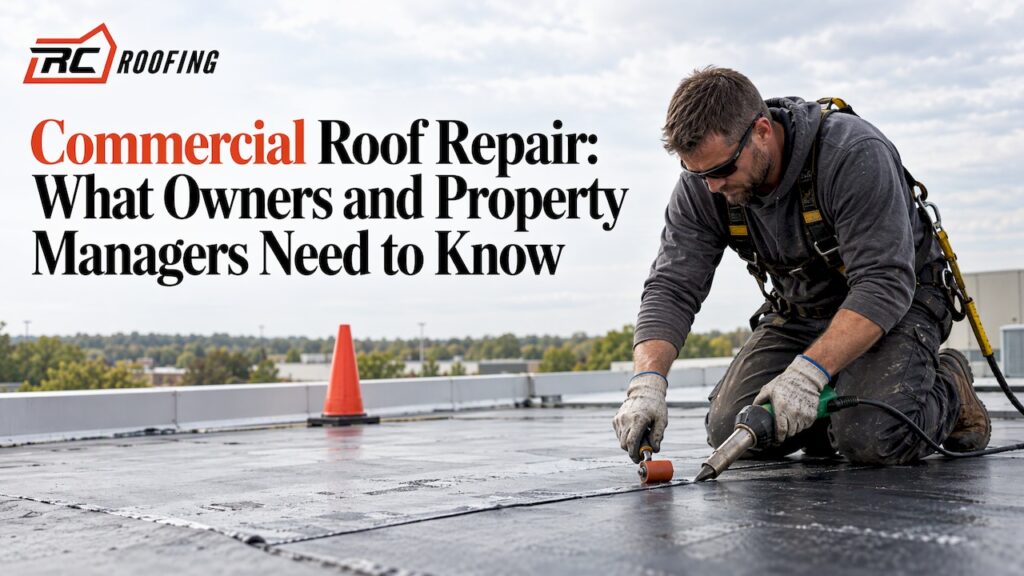
| TPO and PVC (heat-welded single-ply membranes) | Failed seams, punctures, flashing details | Cleaning and welding a new patch or seam over the damage |
| EPDM (rubber membrane, not heat-welded) | Aged or failed splices, tears | Primer and adhesive or peel-and-stick patch material over the damage |
The ICLR guidance says built-up and modified-bitumen roofs should be checked for blisters, cracks, connection wear, tears, punctures and weathering that strips gravel or coating. For metal panels it points to worn paint, rust and dents, because the paint is part of the corrosion protection.
On single-ply roofs, a trade resource explains that TPO and PVC are heat-welded, and that a TPO seam failure can be re-welded by a trained technician. EPDM repairs use membrane with primer and splice adhesive or peel-and-stick material rather than welding.
Flat roofs have a particular weakness: water that does not run off. If your building has one, our page on flat roof repair covers leaks and lifespan, and membrane patching is a common fix for punctures and open seams. Poor drainage causes ponding, so gutters, scuppers and drains are part of the repair conversation too, and we handle roof drainage repair and gutter repair.
How a commercial roof repair works, step by step
A good repair follows a sequence. Skipping the early steps is how a leak comes back.
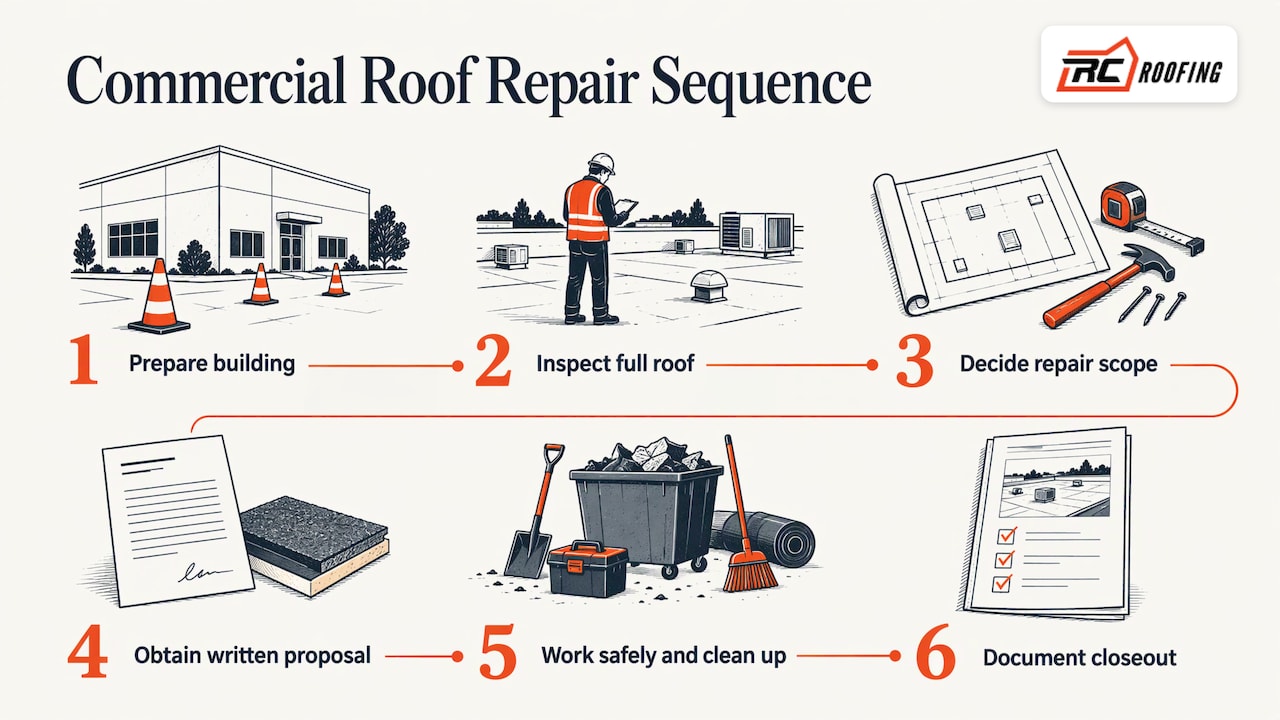
1. Prepare the building
Tell tenants, staff and your insurance contact about the problem. Photograph interior damage and note the date and weather. Move stock and protect equipment under the affected area. If the cause was a storm, keep records of the event, because insurers will ask for them.
2. Get a full inspection, not just a look at the leak
Water travels. The spot where it drips inside is often far from where it enters. A thorough inspection checks the membrane, seams, flashings, penetrations (pipes, vents, rooftop units), drains and edges, and compares what is found on the roof with what shows on the ceiling below. The goal is a detailed report that names each problem, where it is and how serious it is.
This is the step we put the most care into. Our inspections are thorough and come with detailed reports, and they are free, so you can see the whole picture before you decide anything. For what the process can turn up, read 7 problems a commercial roof inspection can reveal, and see our local page on commercial roof inspection in Washington, MO.
3. Decide the scope: spot repair, section repair or replacement
The next section covers this decision. The key point is to ask for it in writing, with the reasoning, not just a price.
4. Get a written scope and a line-item proposal
IBHS recommends comparing line-item bids and requiring documentation of materials, methods, permits, warranties, testing, cleanup and closeout. A proposal that says only “repair roof leak” with one number does not give you anything to hold the contractor to.
5. Do the work safely and clean up
The crew should have a safety plan, protect the occupied building below, and leave the roof and site clean. Ask when the work will happen so you can plan around deliveries, customers and tenants.
6. Close out with documentation
You should end up with photographs, a description of what was done, the warranty terms in writing and any recommendations for follow-up. Put them in a roof file. Those records matter for insurance claims, for future buyers and lenders, and for any manufacturer warranty on the membrane.
Repair or replace: how the decision is made
A leak alone does not mean the roof is finished. Localized causes such as open seams, damaged flashing, punctures, penetrations and drainage defects can often be repaired. The question is whether the damage is isolated or the whole system is failing.
A manufacturer’s commercial roofing decision guide works through it in order. A compromised structural deck overrides everything else and points to full replacement. Widespread wet insulation or two existing roof layers points to tear-off and replacement. A generally stable system points to recovering or repairing it.
In practical terms:
Repair is usually the right call when:
- leaks are isolated to a few spots
- the membrane is mostly intact
- insulation below is dry or only wet in a small area
- the deck is solid
- the trouble is seams, flashing, penetrations or drains
Replacement deserves serious consideration when:
- moisture has spread through large areas of insulation
- the deck is damaged
- the membrane is failing across much of the roof
- drainage problems cannot be corrected
- the same areas have been repaired again and again without lasting results
If the deck itself is in question, our guide on when a structural roof assessment and an engineer are needed explains the next step. If replacement is the honest answer, we will say so and walk you through roof replacement. If a repair will do, we will say that too. Honest advice on repair versus replacement is part of how we work.
What affects the price of a commercial roof repair
No honest contractor can quote a commercial repair without seeing the roof. Prices depend on the roof system, how much damage there is, how easy the roof is to reach, how many penetrations and details are involved, whether insulation has gotten wet, and local labor. Proposals also differ in the membrane and thickness, insulation, how much material is torn off, and the type of warranty included.
That is why a published “cost per square foot” figure is a poor way to budget. Use it only to sense the range, then get a real number from an inspection. For a general look at what drives the numbers, see our page on roof repair costs.
When you compare bids, compare the same scope. A low number that leaves out flashing work, drainage fixes or cleanup is not a lower price, just a smaller job.
How to choose a commercial roof repair service
IBHS describes the commercial roof as the building’s first defense against wind, rain, hail, ice and snow, and recommends hiring a qualified licensed or bonded contractor whose references and liability coverage have been checked. Use this checklist:
- License or bond. Confirm what applies in your city or county and that it is current.
- Insurance. Ask for certificates showing general liability and workers’ compensation coverage.
- References. Ask for commercial or similar-building jobs you can verify.
- Manufacturer certification where your membrane warranty requires it.
- Written scope. Materials, methods, permits, testing, cleanup and warranty in writing.
- Safety plan. The crew should have a named person responsible for safety on site.
- Warranty. Know what it covers, for how long, and who stands behind it.
Pay attention to who will actually answer the phone after the job. A roof is a long-term relationship, and local contractors are the ones who can get back to your building quickly. We are a licensed and insured family-owned crew with a 5.0 rating on Google from more than 275 customers, and our work is covered by a lifetime workmanship warranty. Our commercial roofing contractor page explains how we approach these projects.
Be cautious after storms, too. Out-of-town crews often canvass neighborhoods and business parks, and unverified door-knockers are a common source of trouble. Our guide to roof repair scams Missouri property owners should avoid lists the warning signs.
Preventing the next repair: inspections and maintenance
The cheapest repair is the one that stays small. Manufacturers and trade groups agree on the basics:
- GAF recommends inspections at least once a year, ideally twice, in spring and fall, and after severe weather, along with clearing debris and drains, checking metal, masonry and rooftop equipment, limiting roof traffic and keeping records.
- SPRI, the single-ply roofing industry association, says low-slope roofs should be inspected at least twice a year and after any major storm, checking perimeters for loose metal or fasteners, flashings around penetrations and open drains.
- Johns Manville’s owner manual says a maintenance program typically costs 1 to 3 percent of the estimated replacement cost per year and can extend the roof’s life well beyond a replace-every-15-to-20-years pattern.
In Franklin County and the greater St. Louis area, roofs go through freeze and thaw cycles, summer heat, heavy rain and hail. A spring inspection finds winter damage, and a fall inspection gets the roof ready for the cold. For scheduling guidance, see how often a roof inspection should be scheduled, and for a routine that fits your building, our preventive roof maintenance page explains what we do.
Between visits, keep drains and scuppers clear, restrict foot traffic to marked paths, make sure HVAC technicians report any roof damage, and file every report and invoice.
Commercial roof repair with RC Roofing and Contracting
We repair, replace and maintain roofs for residential and commercial properties in Washington, MO and Franklin County, and we also serve nearby communities including Washington, Union-area towns, St. Charles, St. Peters, O’Fallon, Chesterfield, Wildwood, Kirkwood and St. Louis County. For a business owner or property manager, that means one local contractor for inspection, repair, drainage, gutters and, if it comes to that, replacement.
Our commercial roofing services start with a free inspection and a detailed report, followed by honest advice on repair versus replacement, a transparent process and clear communication throughout the job. Every project is tailored to the local climate and the style of your building.
If you have a leak, ponding or storm damage, request a free roof inspection and get a written picture of what your roof needs before you spend anything on repairs.
FAQ
How fast should a commercial roof leak be repaired?
As soon as possible. Water that stays in insulation and the deck spreads the damage and can lead to mold, damaged ceilings and ruined stock. Protect the interior right away, arrange a temporary fix if needed and book an inspection so the permanent repair addresses the real source.
Does a leak mean I need a new roof?
Not necessarily. Many leaks come from localized problems such as seams, flashing, penetrations or drains. Replacement becomes the better path when moisture is widespread, the deck is damaged or the membrane is failing across large areas. An inspection report tells you which situation you are in.
How often should a commercial roof be inspected?
Trade guidance from GAF and SPRI says at least once a year, and ideally twice, in spring and fall. Add an inspection after any severe storm, hail or high wind. Keep each report so you can track the condition over time.
What should a commercial roof repair proposal include?
A description of the problem and where it is, the materials and methods, permits if needed, a line-item price, cleanup, the warranty terms and a schedule. The more specific the scope, the easier it is to compare proposals fairly.
Do you handle commercial properties outside Washington, MO?
We serve Washington, MO, Franklin County and surrounding communities across the St. Louis area, including St. Charles, St. Peters, O’Fallon, Chesterfield and Kirkwood. Call or use our commercial roofing page to confirm your location.
Sources
- ICLR: How to inspect and maintain your commercial roof
- Insurance Journal: A guide to commercial roof inspection
- IBHS: Commercial roofs best practices
- Elevate: Commercial roofing decision guide
- The Roofing Brief: Commercial roof repair costs
- CapXos: When does a commercial roof need repair
- GAF: Commercial scheduled maintenance checklist
- SPRI: Frequently asked questions
- Johns Manville: Owner’s manual