Peaks and valleys, angles and alleys, a beautiful roofline can turn complicated fast when storms, age, and water all find different paths across it. If your Villa Ridge home has dormers, multiple slopes, chimneys, valleys, wall intersections, or additions, have you ever wondered what it actually takes to replace every section correctly? A complex roof replacement Missouri homeowners can depend on is not simply a matter of removing old shingles and laying down new ones. Every transition must shed water correctly, every vulnerable junction needs the right flashing, and every roof plane has to work as part of one complete system.
For Villa Ridge homeowners, that level of detail matters. Complex roofs are common on larger homes, custom builds, additions, and properties that have evolved over time. They can be beautiful, but they also create more places where water can collect, wind can lift materials, and flashing mistakes can turn into leaks.
Why Complex Rooflines Need More Than a Standard Tear-Off
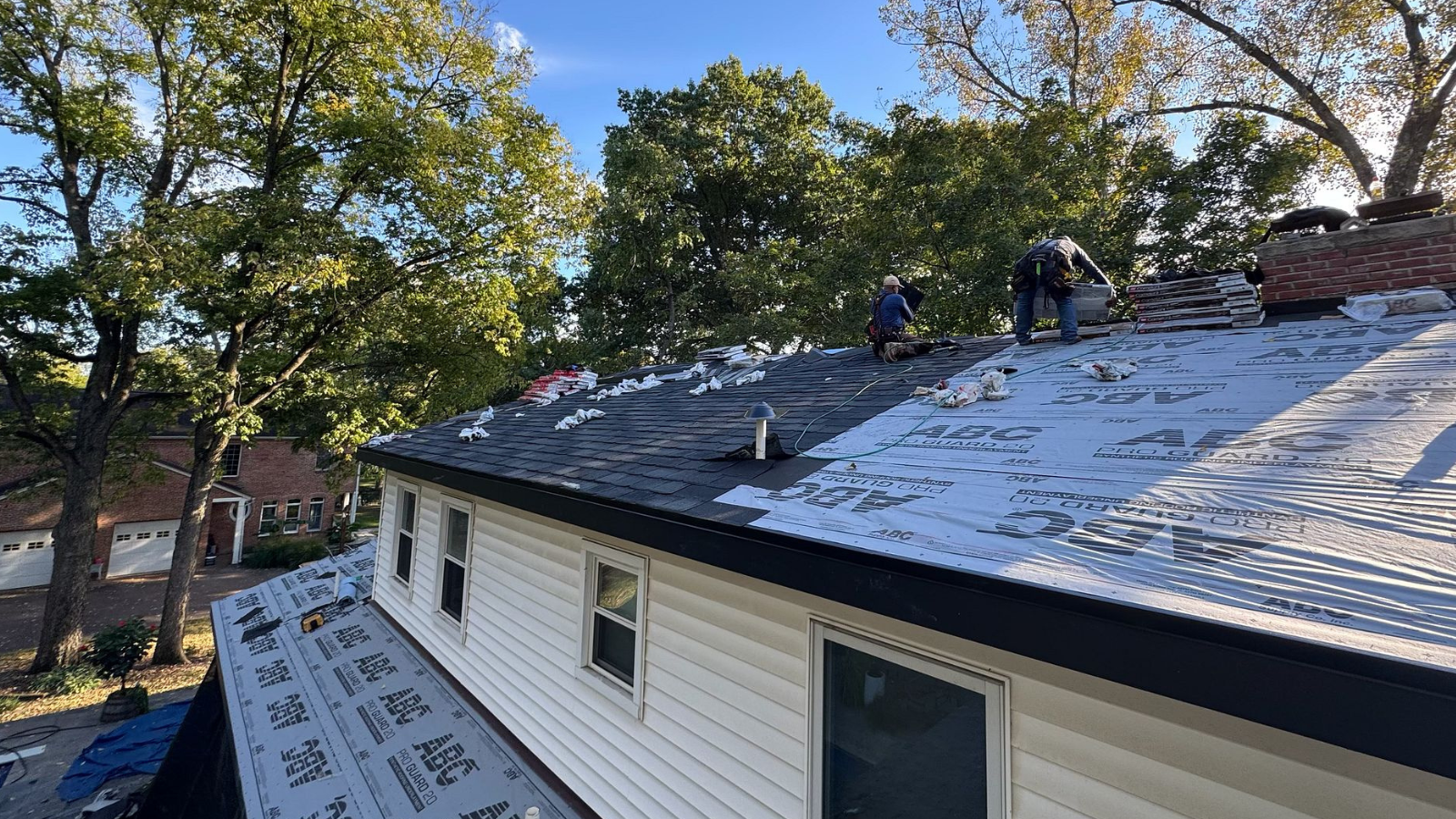
A simple gable roof has relatively few transitions. Water generally moves down two broad slopes toward the gutters.
A complex roof can have five, ten, or even more roof planes intersecting at different heights and angles.
Those intersections create valleys, hips, ridges, sidewalls, headwalls, dormers, chimneys, porch tie-ins, skylights, and roof-to-wall connections. Each one changes the way rainwater and wind move across the structure.
That is why complex roof replacement Missouri projects require careful sequencing. Roofing crews cannot treat one slope as though it exists by itself. The underlayment, flashing, shingles, ventilation, and drainage details need to overlap in the correct order so water continually moves down and away from the home.
A detail that looks minor during installation can become extremely important during the next Missouri downpour.
Villa Ridge Weather Gives Those Details a Real Test
This is not an abstract concern for local homeowners.
According to the National Weather Service, the March 14, 2025 tornado outbreak caused EF-2 damage in Villa Ridge, including major damage to a home’s roof structure.
More recently, on August 12, 2026, the National Weather Service issued a severe thunderstorm warning covering southern Franklin County that specifically included Villa Ridge. The warning called for wind gusts up to 60 mph and stated that damage to roofs, siding, and trees was expected.
Those events do not mean every Villa Ridge roof is damaged. They do show why roofing details matter here.
Wind pressure can attack roof edges, ridges, corners, and changes in geometry differently. A complex home simply has more of those transitions.
Our recommendation is simple: if your home has a complicated roofline and has been through significant wind, hail, or falling debris, do not judge its condition only from the driveway. Have the entire roofing system evaluated, including the sections that are difficult or impossible to see from ground level.
What Makes a Roofline Complex?
You do not need to know roofing terminology to recognize a complicated roof.
In practical terms, complexity increases whenever multiple roof surfaces intersect or architectural features interrupt the normal path of water.
That can include multiple valleys, dormers, chimneys, skylights, turrets, attached garages, porch tie-ins, several roof pitches, additions built at different times, and low-slope sections connected to steeper roofing.
The more of these features your home has, the more important installation planning becomes.
During a complex roof replacement Missouri project, experienced contractors think about those connections before tear-off begins.
Where will rainwater concentrate?
Which sections need step flashing?
Does an upper roof empty onto a lower one?
Are there valleys where debris naturally collects?
Do wall intersections need new flashing?
Can the gutter system handle concentrated runoff?
The answers should be clear before new shingles begin covering everything again.
Valleys: Where a Lot of Water Meets in One Place
Roof valleys are among the most important parts of a complicated roof because they collect runoff from two adjoining slopes.
During heavy rain, a valley can carry a significant amount of water in a short period. Leaves, needles, sticks, and other debris can also collect there, particularly on properties surrounded by mature trees.
That means valleys need more than neat-looking shingle lines.
The underlayment and valley system have to be installed correctly, and the finished roofing needs to allow water to move freely instead of creating places where debris and moisture remain trapped.
On a complex roof replacement Missouri job, professionals should also inspect the roof deck beneath old valley areas.
If a valley leaked in the past, the sheathing underneath may show staining, deterioration, softness, or other signs of repeated moisture exposure.
Finding that damage while the roof is open is far better than covering it with another roofing system.
Roof-to-Wall Intersections Demand Careful Flashing
Dormers, second stories, garages, additions, and other architectural features often create areas where a roof slope runs directly into a vertical wall.
These can become high-risk leak locations if the flashing is poorly installed.
According to U.S. Department of Energy Building Science Education guidance, step flashing should be used where a roof meets a wall, such as beside a dormer. Its purpose is to protect that transition from water intrusion while allowing water to continue draining over the roofing system.
That concealed detail can separate a careful complex roof replacement Missouri project from one that simply looks good on installation day.
Homeowners typically notice the shingles.
They rarely see the flashing underneath them.
Yet that hidden metal can be one of the most important barriers preventing rainwater from entering the wall assembly.
Kick-Out Flashing Helps Finish the Job
There is another important detail where some roof-to-wall intersections end near the gutter.
It is called kick-out flashing, sometimes referred to as a diverter.
Its purpose is to direct runoff away from the wall and into the gutter rather than allowing water to continue flowing against the siding.
Department of Energy Building Science Education guidance describes kick-out flashing as an important way to direct roof runoff into gutters and protect walls from water intrusion.
For Villa Ridge homes with dormers, attached garages, additions, or roofs that terminate against exterior walls, this small detail can have a big job.
A new roof should not create a beautiful shingle field while leaving one of the most vulnerable water transitions untouched.
Chimneys Create Several Challenges at Once
A chimney interrupts a roof in several directions.
Water reaches the uphill side, runs along both sides, and eventually needs a clear path around the lower portion.
Depending on the chimney width and roof configuration, a cricket or saddle may also be needed to help move water around the obstruction.
Flashing has to work with both the masonry and the roof covering.
A complex roof replacement Missouri contractor should therefore look at chimney flashing as part of the replacement plan rather than simply cutting new shingles around whatever happens to be there.
Old caulk, patchwork, deteriorated metal, or previous short-term repairs can all become hidden weaknesses beneath a brand-new roof.
Roof replacement gives contractors a valuable opportunity to correct those details while the surrounding materials are already removed.
Dormers Add Character and More Places to Inspect
Dormers add character to a home and can create valuable upper-level space, but they also add more roofing transitions.
One dormer can introduce two sidewalls, corners, a headwall, and additional valley or flashing conditions.
Multiple dormers multiply those areas across the home.
During replacement, contractors should inspect decking around each dormer, evaluate sidewall and headwall flashing, check corners carefully, and make sure runoff has a clear path toward the gutters.
This is one reason a complex roof replacement Missouri project can demand considerably more attention than a simple roof of the same overall square footage.
Complexity is not just about how many bundles of shingles are required.
It is about how many transitions need to be rebuilt correctly.
Different Roof Pitches Need Different Treatment
Complex homes often combine steep architectural roof sections with lower-slope porches, garages, or additions.
Those sections should not automatically be treated identically.
Roof pitch affects drainage speed, underlayment requirements, fastening details, and which roofing materials are appropriate.
An experienced crew identifies those changes before installation begins.
During a complex roof replacement Missouri project, each section needs to be built for its specific slope while still connecting correctly to the remainder of the roofing system.
The Roof Deck Needs Attention Before It Disappears Again
One of the most important moments in any replacement happens after the old roofing materials come off.
For a short period, the roof deck is exposed.
This creates an opportunity that may not come again for decades.
FEMA’s current Wind Retrofit Guide for Residential Buildings recommends inspecting existing roof decking when roof coverings are replaced. FEMA’s guidance includes identifying damaged or deteriorated roof decking or framing and repairing or replacing compromised areas. It also identifies roof deck attachment and water intrusion resistance as important parts of improved roof performance.
That matters even more on complicated homes because previous moisture problems often occur around valleys, dormers, chimneys, penetrations, and wall intersections.
A complex roof replacement Missouri homeowner should expect the roof deck to receive attention rather than watching new materials immediately cover whatever the crew discovers.
If portions are rotten, soft, delaminated, or otherwise structurally compromised, correcting those areas gives the new roof a stronger foundation.
Underlayment Is the Backup Layer You Rarely See
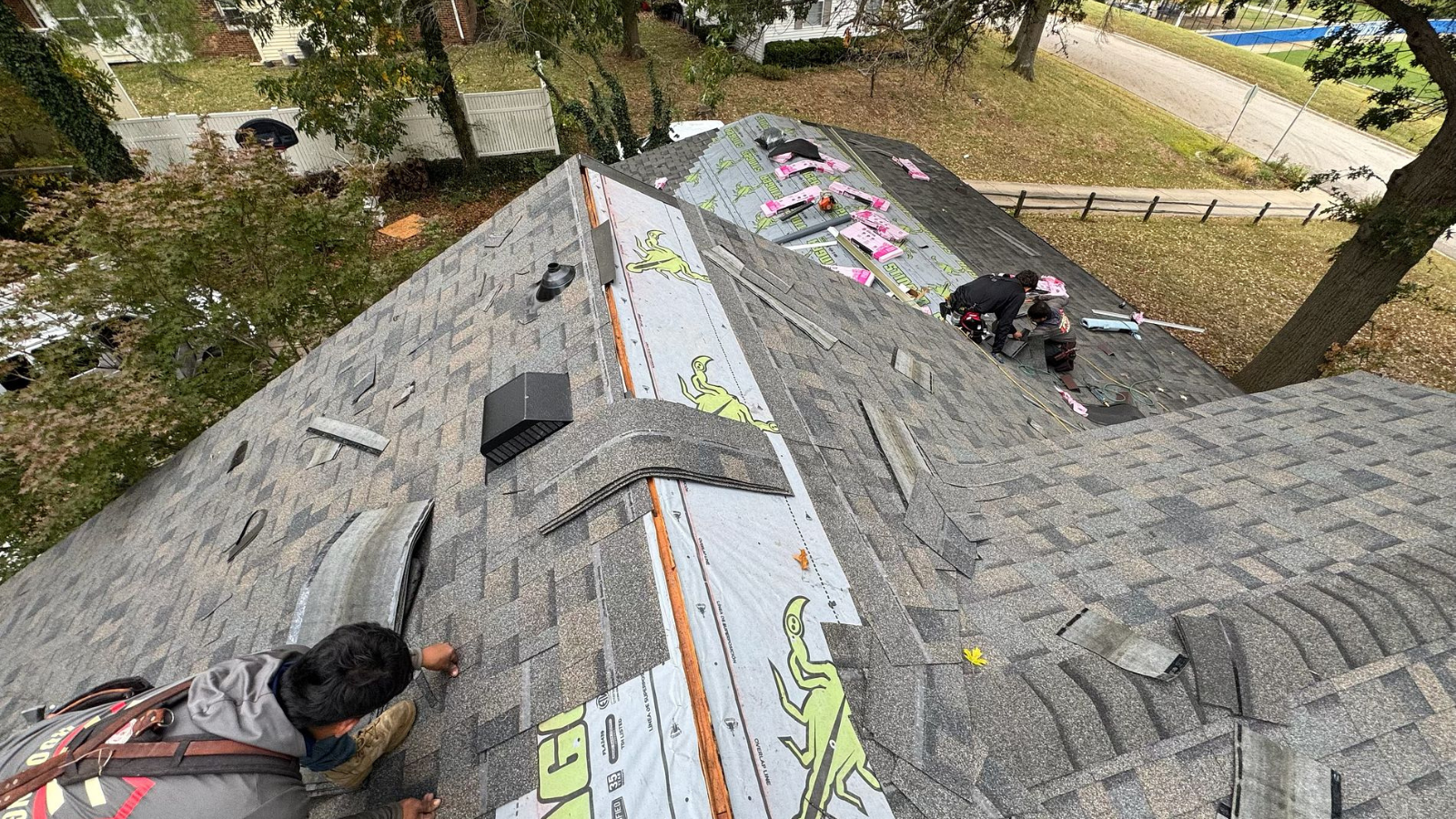
Shingles get most of the attention because they are visible. Underlayment quietly works beneath them.
Installed over the roof deck and below the finished roofing material, it provides another protective layer within the roof assembly.
On complicated roofs, underlayment details become especially important around valleys, eaves, penetrations, and transitions where water is more likely to concentrate.
Products and installation requirements vary according to the roofing material, roof slope, manufacturer specifications, and project conditions.
The important takeaway for homeowners is simple.
In a complex roof replacement Missouri project, hidden layers should never be treated as an afterthought just because nobody will see them once the project is finished.
Every Penetration Has to Stay Watertight
Plumbing vents, exhaust vents, skylights, attic vents, and other openings interrupt the shingle field.
Each needs a dependable method of water management.
Pipe boots can deteriorate. Old flashing may crack. Skylight flashing may have been patched several times. Sealants can eventually reach the end of their useful life.
Roof replacement is an ideal time to evaluate these components because the roofing surrounding them is already being disturbed.
A quality complex roof replacement Missouri plan accounts for every penetration instead of simply working around it.
The fewer shortcuts taken around small details, the fewer vulnerable places water can exploit later.
Ventilation Still Matters on a Complicated Roof
A new roof is not only responsible for keeping rain outside.
What is happening in the attic matters too.
The U.S. Department of Energy’s Guide to Durable Attics identifies moisture as a major threat to attic durability and notes that roof leaks, improperly installed flashing, and inadequate ventilation can contribute to moisture problems that may damage roofing materials and insulation.
Complex rooflines can make ventilation more challenging because different attic spaces may not always communicate freely.
Dormers, additions, vaulted ceilings, separate wings, and other architectural features can change airflow.
During a complex roof replacement Missouri project, the contractor should understand the existing attic ventilation system rather than assuming that seeing a few vents on the roof means airflow is automatically balanced.
Water Has to Leave the Roof Somewhere
Every roof needs a drainage plan.
Complex rooflines make that plan even more important.
Imagine an upper roof emptying onto a lower slope. The lower roof now receives both direct rainfall and concentrated runoff from above.
Add a valley feeding into that same section and the amount of water increases again.
Now imagine that water reaching a small gutter, clogged downspout, or poorly positioned drainage point.
This is why professional roofing involves more than laying shingles.
The crew should understand where water travels after it lands on the roof.
For Villa Ridge homeowners, one recommendation is particularly useful: ask your contractor where the heaviest runoff travels on your home.
You do not need a technical drainage map. You should simply be confident that water from multiple slopes has a logical, unobstructed route away from the structure.
Why Ridges, Edges, and Corners Deserve Extra Attention
Wind does not affect every part of a roof in exactly the same way.
Edges, ridges, corners, and changes in geometry can experience different wind forces than broad interior sections.
Complex homes naturally have more of these areas.
Installation should therefore follow the fastening pattern, starter-strip requirements, ridge details, underlayment instructions, and manufacturer specifications appropriate for the roofing system.
Villa Ridge’s weather history reinforces why those details should not be rushed.
The National Weather Service has documented damaging winds affecting the community as well as significant tornado damage to residential roofs.
A complex roof replacement Missouri homeowner does not need to become a roofing engineer, but asking how these high-exposure sections are being installed is completely reasonable.
What Pros Watch at Every Major Section
| Roof Area | What Professionals Check | Why It Matters |
| Valleys | Deck condition, underlayment, roofing layout and drainage | Large volumes of water concentrate here |
| Dormers | Step flashing, corners, valleys and headwalls | Multiple transitions exist in a small area |
| Chimneys | Flashing, masonry interfaces and uphill drainage | Water must move around a major obstruction |
| Roof-to-wall areas | Step flashing and kick-out flashing | Poor details can direct water into walls |
| Low-slope sections | Roofing and underlayment requirements | Slower drainage may require different methods |
| Roof penetrations | Boots, flashing, seals and condition | Small openings are frequent leak points |
| Hips and ridges | Fastening, caps and ventilation details | High areas receive significant weather exposure |
| Roof decking | Rot, softness, delamination and attachment | The new roof depends on a sound foundation |
| Gutters and drainage | Runoff concentration and discharge | Complex roofs can concentrate large volumes of water |
The point is not to make your roof sound frighteningly complicated.
It is to show why every section deserves deliberate attention.
Why the Cheapest Estimate May Not Be the Best Comparison
Roof replacement pricing matters, and homeowners should absolutely compare proposals.
On a complex roof, however, comparing only the total price can be misleading.
One estimate may account for flashing replacement, decking contingencies, detailed valley work, steep sections, multiple penetrations, ventilation corrections, and different roof pitches.
Another may assume many existing components can simply remain in place.
Those may not be equivalent scopes of work.
For a complex roof replacement Missouri estimate, ask what is actually included.
How will deteriorated decking be handled?
What happens around the chimney?
Will old flashing be reused or replaced?
How will dormers be treated?
Are low-slope areas included?
How are pipe boots, skylights, and other penetrations handled?
What workmanship protection applies?
Clear answers help you compare actual value instead of automatically choosing the lowest number.
RC Roofing’s Recommendation for Villa Ridge Homeowners
If your Villa Ridge home has several rooflines, dormers, valleys, additions, chimneys, or mixed pitches, think of replacement as a complete roofing-system project rather than a shingle project.
Ask your contractor to identify the complicated areas before work begins.
Where are the primary valleys?
Which roof sections intersect walls?
How will dormers and chimney flashing be handled?
Does the house contain different roof pitches?
Will the deck be inspected once the tear-off is complete?
How does attic ventilation work throughout the different sections?
Where does the heaviest rainwater runoff travel?
These questions do not make you difficult.
They make you informed.
A complex roof replacement Missouri project should leave you confident about the details you will no longer be able to see after installation is complete.
Final Thoughts: The Most Important Parts of Your Roof May Be the Ones You Never See
A dramatic roofline is designed to catch your eye. A properly installed replacement is designed to keep you from thinking about it when the next Missouri storm rolls over Villa Ridge.
That is the difference that matters.
Valleys have to drain. Dormers need proper flashing. Chimney transitions must stay protected. The roof deck has to be sound. Penetrations must remain watertight. Lower roof sections need to handle runoff from above. And every roof plane needs to connect to the next in the correct order.
That is what professional complex roof replacement Missouri work is really about.
It is not simply putting new shingles where the old shingles used to be. It is rebuilding the home’s weather protection one critical section at a time so the entire roof works together.
Because the parts of your roof your neighbors never notice may be the exact parts standing between your home and the next hard Missouri rain.