Most downspout problems come down to four things: a loose connection, a leaking joint, a clog or a crushed section. The first three are usually small fixes. A crushed or split section is replaced. If the trouble is a sagging gutter, rotted fascia or water that still backs up after the spout is clear, the downspout is only the symptom. That is the point where a roofing contractor earns the call. For homes in Villa Ridge and across Franklin County, we do that work every day, and this guide shows you how to tell which situation you have.
Key Takeaways
- Match the fix to the problem: reseat and screw a loose spout, reassemble a leaking joint before you reach for sealant, flush a clog from the top, and replace any section that is split or creased.
- A spout should carry water 4 to 6 feet away from the foundation. A repair that does not do that is not finished.
- Small repairs are modest in cost. This Old House puts gutter repair at $25 to $200, depending on type and extent.
- Repeat overflow, sagging gutters, stripped screw holes, a tall house or power lines nearby are signs to bring in a professional.
Table of Contents
- Signs your downspout needs repair
- Repair or replace: how to decide
- How to fix the common downspout problems
- Make sure the water goes somewhere safe
- Ladder and roof safety
- What downspout repair costs
- When the problem is bigger than the downspout
- Why a local roofer for gutter and downspout work
- A simple yearly routine
- FAQ
- Sources
Signs your downspout needs repair
You do not need to climb anything to spot most problems. Walk the house during a heavy rain and look for these:
- Water pouring from a seam instead of out of the bottom of the spout.
- Gutters overflowing while the downspout stays nearly dry, which usually means a blockage.
- Pooling or soft ground near the foundation where the spout ends.
- A spout pulling away from the siding, hanging at an angle or rattling in the wind.
- Visible dents, cracks, holes or rust.
A quick test is to pour water into the gutter and watch whether it flows out of the downspout, a check Roto-Rooter describes for finding blockages. A hose does the same job.
A home inspector looks at a longer list. According to InterNACHI, the home-inspection association, that list covers the downspout-to-gutter connection, how well the spout is attached to the house, leaking joints (some are installed upside down), impact damage from parked vehicles, and spouts that empty onto another roof. It is a good checklist for your own walk-around.
Repair or replace: how to decide
The deciding factor is the condition of the metal and where the water ends up.
| What you see | Usual answer |
|---|---|
| Loose strap, missing screws | Repair |
| Leaking joint | Repair, then replace the section if the metal is corroded |
| Clogged elbow or spout | Clear it, then repair any damage the backup caused |
| Shallow dent, no crease | Repair |
| Split, creased or crushed metal | Replace the section |
| Widespread rust or holes | Replace |
| Water backing up after a clear spout | Inspect the gutter run, slope and outlet |
Gutters in our area take a beating from heavy rain, ice and falling limbs. Old downspouts on older Villa Ridge farmhouses and Franklin County ranch homes often carry decades of wear at the joints and straps, so a quick repair on one section can turn into a conversation about the whole run.
How to fix the common downspout problems
These are straightforward repairs when you are working from the ground or a low, stable ladder. Always follow the safety notes in the next section first.
A loose or disconnected downspout
Loose downspouts are usually caused by missing or torn-out screws. The fix is to fit a downspout drop outlet into the gutter, seal and screw it in place, set the spout onto the outlet from the bottom, screw it in at two or more points and strap it to the wall. This Old House recommends short aluminum pan-head screws for elbows and sections, aluminum straps near the upper and lower ends, and a screw through the upper end into the outlet.
If the old screw holes are stripped out, a new screw will not hold. That is a job for a professional, because the fix is often a new outlet or new fascia backing rather than a longer screw.
A leaking joint
Most people reach for caulk first. The better order is mechanical first, sealant last. The Roofing Brief lays out the sequence:
- Run a hose through the gutter and mark every spot that drips.
- Back out the screws and take the joint apart.
- Reassemble it with the crimped end pointing down, so water runs inside the next section rather than out of the seam.
- Drive one 1/2-inch rust-resistant screw on each side.
- Add a small bead of gutter sealant only if the joint still weeps.
If you do seal, clean old caulk and adhesive off both parts with a stiff wire brush and apply a bead to one part before reassembling, as The Home Depot’s leak guide describes. The same guide notes that most gutter leaks show up at seams and end caps, and that a leak at the elbow or outlet may really be a clog. Check for a blockage before you take anything apart.
A clogged downspout
- Clear leaves and debris from the gutter and the top elbow by hand, wearing gloves.
- Flush from the top with a hose for two to three minutes, as The Roofing Brief advises. Seal joints only after flow is restored.
- If water still backs up, Lowe’s suggests feeding a hose nozzle up from the bottom at full pressure. If that fails, use a hand auger (a plumber’s snake). Lock the collar when the auger stops, spin it as you feed it in, then pull it back to release the debris.
- If the spout is one solid piece, take off the bands, slide it out, flush it and reattach it.
If the spout clears but the yard stays soggy or a wet spot appears in the lawn, the problem may be a break in an underground drain line. That calls for a closer look, not another hose flush.
A dented downspout
For a shallow dent, slide a 24-inch length of 2×2 lumber or a broom handle inside and press the face back out (The Roofing Brief). If the metal is split or creased, replace that section. A dent that is pushed out but left creased will catch debris and clog again.
A crushed bottom elbow
The bottom elbow takes the most abuse from mowers, vehicles and foot traffic. It is replaced, not repaired. According to November 2026 Home Depot listings reported by The Roofing Brief, a 2×3 aluminum A elbow costs $2.80 to $3.44. Retail prices change, so check the store for the current price.
Make sure the water goes somewhere safe
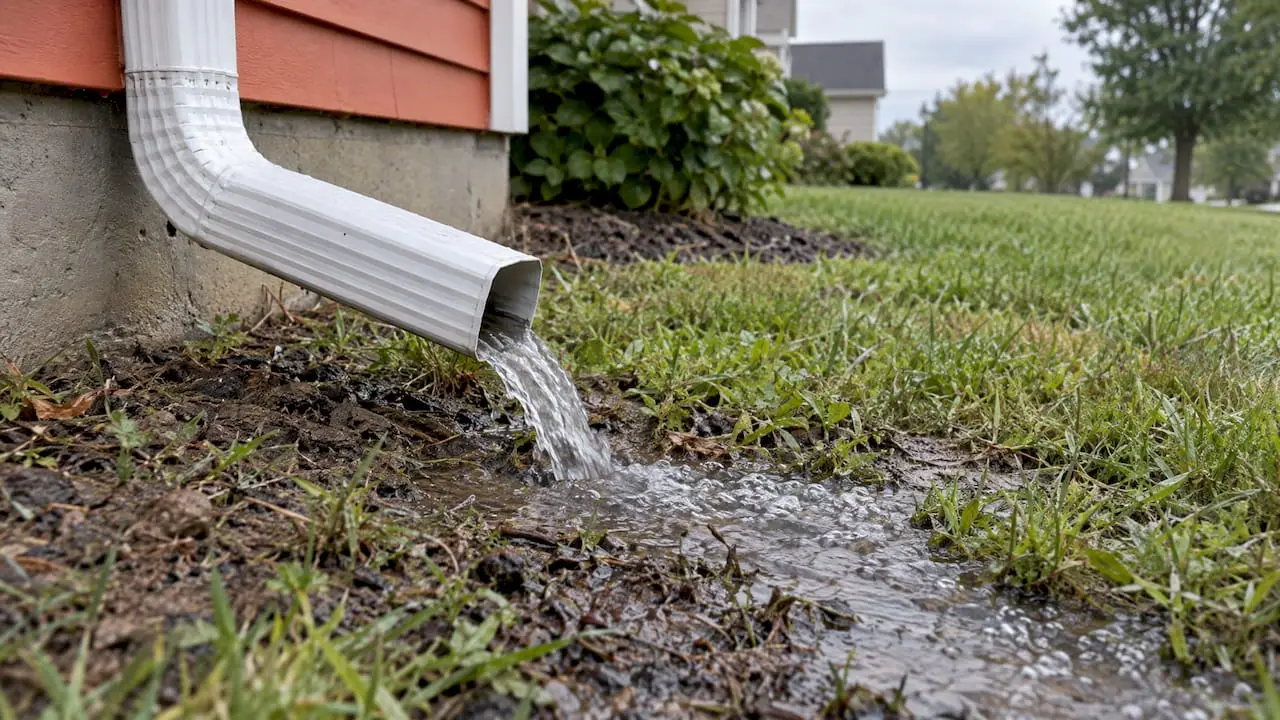
A repaired downspout that dumps water at the foundation just moves the problem. InterNACHI says downspouts should divert water 4 to 6 feet from the foundation. Soggy ground against a foundation is worth fixing right away.
After any repair, run a hose into the gutter for a few minutes and watch three things: no drips from joints, no overflow at the outlet, and water leaving the end of the spout and flowing away from the house. The same source advises flushing while directing water away from the home so you do not saturate the soil next to the foundation.
Gutter pitch matters too. Lowe’s gives the ideal slope as a 1/4-inch to 1/2-inch drop every 20 feet toward the downspout, with hangers every 2 feet. The Home Depot states a figure of about a quarter inch every 10 feet. Either way, standing water in a gutter run means the slope or the hangers have failed, and sagging areas may need new hangers.
Ladder and roof safety
Most injuries from gutter work come from the ladder, not the repair. InterNACHI recommends three-point contact on the ladder and moving the ladder rather than over-reaching. Wear gripping footwear and gloves against sharp debris, and expect animals or insects in clogged gutters.
Stay off the ladder entirely if you are uncomfortable on it or if power lines run near the gutters. For tall homes, The Spruce says to hire a professional gutter installer. Our own roof inspection safety guide covers the same ground rules for roof-level work.
What downspout repair costs
For a handful of fasteners, straps and an elbow, parts run a few dollars each. A professional visit costs more because it covers labor, ladder time and the diagnosis. This Old House estimates gutter repair at $25 to $200, taking 2 to 4 hours, depending on the type and extent of the work.
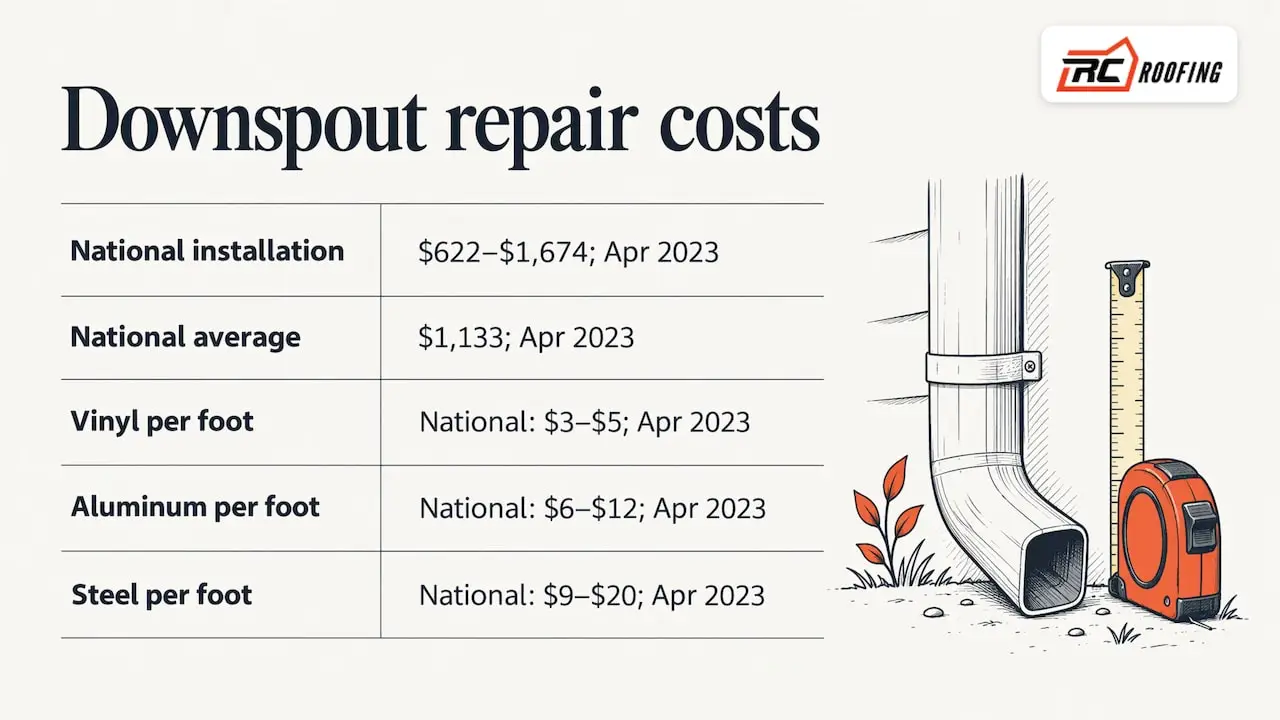
Replacing larger sections or the whole system is a different scale. The Spruce reports that professional gutter installation with seams costs between $622 and $1,674, averaging $1,133, as of its April 2023 update. Per linear foot it lists $3 to $5 for vinyl, $6 to $12 for aluminum and $9 to $20 for steel. Those are national figures. Your own price depends on the height of the house, the number of downspouts, access and the condition of the fascia behind them. We do not publish prices, because we quote after seeing the job.
When the problem is bigger than the downspout
A downspout is the last link in a chain that starts at the roof edge. If you keep fixing the spout and the problem returns, look upstream. Lowe’s lists these cases for professional help:
- Overflowing gutters that cleaning and unclogging do not fix.
- Sagging gutters that need inspection for gutter or fascia board replacement.
- Loose screws with stripped-out holes.
- A ladder you are not comfortable on, or power lines near the gutters.
There are roof-related causes as well. Water that spills past the gutter instead of into it, shingles shedding granules into the gutter, and wet fascia or soffits all point to the roof edge and drainage, not the spout. Our guide to professional roof repair signs shows what to look for at the roofline.
Storm season adds its own pattern. Hail dents spouts and gutters, wind pulls straps loose and falling limbs crush sections. If a storm did the damage, fix the downspout, but also have the roof checked, since the same storm may have damaged shingles. Our storm damage restoration process guide explains what happens next.
A note on insurance claims
If storm damage to your gutters or roof goes through an insurance claim, Missouri law applies to the contractor you hire. Under RSMo 407.725, a contractor may not advertise or promise to pay or rebate any part of an insurance deductible as an inducement to sell goods or services. That includes discounts and allowances against the fees, and gifts or credits of monetary value. The statute also lets a person who signed a written contract to be paid under an insurance policy cancel it within a set period, so read what you sign. Your deductible is yours to pay, and any contractor who offers otherwise is working outside Missouri law.
Why a local roofer for gutter and downspout work
Gutters, downspouts, fascia and the roof edge work as one system, and the best repair looks at all of it. We are RC Roofing and Contracting, a family-owned, licensed and insured company serving Villa Ridge and Franklin County. Our gutter repair service covers gutter and downspout repair and replacement, and our roof drainage repair work handles problems where the roof meets the gutter. We offer free inspections, honest advice on repair versus replacement and lifetime workmanship warranties.

If your downspouts keep failing, or you want someone to check the whole drainage path along with the roof, start with a roof inspection. We write up what we find in a detailed report, so you can see exactly where water is getting in. Our Google rating is 5.0 from more than 275 customers. For a closer look at the fix itself, see our post on gutter repair and preventing water damage.
A simple yearly routine
Most downspout failures are slow. A few minutes twice a year catches them early:
- Late fall, after the leaves drop: clear the gutters and top elbows and flush every downspout.
- Early spring: after winter ice and wind, check straps, screws and joints, and look for sagging runs.
- After any major storm: walk the house for dents, loose spouts and debris.
- Every visit: confirm that water exits 4 to 6 feet from the foundation.
Our seasonal roof repair checklist pairs this routine with a look at the roof itself.
FAQ
How much does it cost to repair a downspout?
Small repairs such as new screws, straps or an elbow cost little in parts. This Old House estimates gutter repair at $25 to $200, depending on type and extent. Replacing whole runs costs more, and the price depends on the house and the material.
Should I use caulk or sealant on a leaking downspout joint?
Reassemble the joint first, with the crimped end pointing down and a 1/2-inch rust-resistant screw on each side. Add a small bead of gutter sealant only if it still drips, as The Roofing Brief explains. Sealant on a badly assembled joint tends to fail.
How far should a downspout drain from the house?
InterNACHI says 4 to 6 feet from the foundation. Use an extension or splash block if your spout ends closer than that.
How do I unclog a downspout?
Clear the top elbow by hand, flush from the top with a hose for two to three minutes, and use a hose nozzle from the bottom or a hand auger if water still backs up. If it keeps clogging, an inspection of the gutter run and slope can find the cause.
When should I call a professional?
Call when the gutters sag, overflow persists after cleaning, screw holes are stripped, the house is tall, or power lines are near the gutters. We serve Villa Ridge and the surrounding Franklin County communities, and you can reach us through our gutter repair page.
Sources
- InterNACHI: Inspecting Gutters and Downspouts
- This Old House: How To Repair a Gutter
- The Roofing Brief: Downspout Repair, Fixes by Problem, Parts and 2026 Costs
- The Spruce: Common Gutter Problems and DIY Fixes at Home
- Lowe’s: How to Clean and Repair Gutters
- The Home Depot: How to Fix a Leaky Gutter
- Roto-Rooter: How to Inspect and Clean Rain Gutters and Downspouts
- Missouri Revisor of Statutes: RSMo Section 407.725