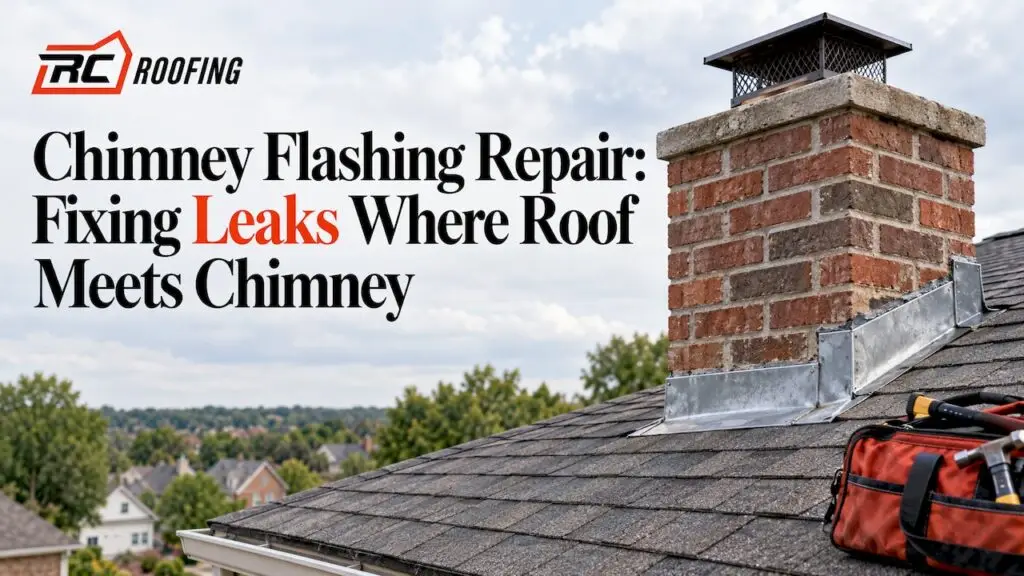
If water is showing up around your chimney, the flashing is the first thing to look at. Flashing is the layered metal that seals the joint between your roof and the chimney. A lasting repair means rebuilding that joint in the right layers, not smearing sealant over a gap. At RC Roofing and Contracting, a family-owned, licensed and insured crew, we inspect chimney leaks for homeowners in Villa Ridge and across Franklin County, and we offer free roof inspections.
Key Takeaways
- Most chimney leaks start at the flashing, the metal seal between the chimney and the shingles, not in the chimney itself.
- A proper repair rebuilds the layers (base flashing, step flashing and counterflashing). Tar or caulk on top of old metal is a short-term patch at best.
- Flashing that is missing, rusted through, falling out or buried in roofing tar generally needs replacing rather than patching.
- Because the metal is under shingles and set into brick, an inspection of the whole roof section around the chimney is the safest way to find the real cause.
- In Missouri, a contractor may not advertise or promise to pay or rebate any part of your insurance deductible. Be wary of any roofer who does.
Table of Contents
- Why the chimney is such a common leak point
- Signs your roof is leaking around the chimney
- What a proper chimney flashing inspection checks
- Repair or replace: how to decide
- What a lasting repair involves
- Why caulk and tar are not a lasting fix
- What affects the price of chimney flashing work
- Will homeowners insurance cover a chimney leak?
- Temporary protection while you wait for a repair
- Chimney flashing repair with RC Roofing and Contracting
- Keeping the joint watertight afterward
- FAQ
- Sources
Why the chimney is such a common leak point
A chimney is a solid masonry stack rising through a roof that flexes with temperature and settles over time. Brick and shingles move differently, and the joint between them has to shed water without being rigid. That is the job of flashing. When it fails, rain runs behind it, into the roof deck and down into the attic or ceiling.
We see this joint described the same way in building guidance. The Building America Solution Center, a U.S. Department of Energy-backed resource, says a brick chimney meeting a roof should use step flashing, base flashing and counterflashing. Each piece has a role:
- Base (apron) flashing sits at the front of the chimney, the low side that faces down the roof.
- Step flashing runs up the sides in small overlapping pieces, each woven under a shingle course.
- Counterflashing is a second layer set into the brick that hangs over the upturned edges of the lower flashing, so water running down the masonry lands on top of the metal instead of behind it.
- A back pan or cricket on the high side handles water coming down the roof toward the chimney.
Fine Homebuilding describes the same stack-up: an apron at the front, a back pan, overlapping step flashing under the shingles at the sides, and counterflashing over the vertical legs. Leaks usually appear when one of those layers is missing, loose, rusted or bridged with sealant.
Signs your roof is leaking around the chimney
The stain on the ceiling is often the last sign, not the first. Family Handyman lists water-stained ceilings near the chimney as a warning of leakage. Watch for these too:
- Brown rings or peeling paint on the ceiling or wall next to the chimney breast
- Damp or musty smell in the attic near the chimney, or dark, wet-looking decking and insulation
- Metal that is visibly rusted, lifted or pulling away from the brick
- Black tar or caulk smeared along the joint, which usually means someone has tried to patch it before
- Cracked or crumbling mortar lines where the counterflashing is set
- Leaks that show up only in wind-driven rain, which often points to a counterflashing or masonry gap
If you are also seeing problems at the top of the stack, our guide to chimney cap roof leak warning signs covers that separate source of water.
Is it the flashing, or something else?
A chimney leak is not always the flashing. Water can come in through the chimney crown, the cap, cracked masonry or even condensation, and it can travel along rafters before it drips, so the stain may be well away from the source. Roof valleys, vents and dormers nearby can also be the culprit. That is why we look at the whole area around the chimney rather than only the metal. If the leak is near a dormer, see dormer roof leaks: five causes to check.
What a proper chimney flashing inspection checks
The American Society of Home Inspectors (ASHI), the professional association for home inspectors, says an inspection should look for rust, loose or opened flashing and installation defects. Its guidance also says to confirm all required flashing pieces are present and that the cap flashing is properly set into the mortar joints.
In practice, a thorough inspection of a chimney leak covers:
- Step flashing along both sides: is every piece there, overlapping correctly and tucked under the shingles?
- Base flashing at the front: is it intact, lapped over the shingles and free of gaps?
- Counterflashing: is it set into the mortar joints, still tight, and overlapping the lower flashing?
- Sealant and tar: is the joint relying on caulk or roofing cement? ASHI notes that caulked or asphalt-cement joints at the top are temporary maintenance items, not permanent solutions.
- Mortar and masonry: are there cracks, open joints or damaged brick that let water in above the flashing?
- Roof deck and attic: is there soft or stained wood, wet insulation or rot beneath the flashing?
- Water flow behind the chimney: is water pooling on the uphill side?
A good inspection ends with a written scope, so you know what is failing, what will be done and why. Our roof inspections come with detailed reports.
Repair or replace: how to decide
Small, isolated problems can sometimes be corrected. A few loose pieces of step flashing, an open mortar joint at the counterflashing, or a short section that has lifted can be reworked when the metal underneath is sound and the surrounding shingles are in good shape.
Replacement is the right call in other cases. Family Handyman advises installing new flashing when it is missing, rusted through, falling out or covered with roofing tar, and whenever new shingles are going on. That last point matters: flashing is woven into the shingles, so a roof replacement is the cheapest time to renew it. Reusing 20-year-old metal under a brand-new roof sets you up for a leak at the one joint most likely to fail.
| Situation | Usually means |
|---|---|
| A few loose or lifted pieces, metal sound, shingles in good condition | Targeted repair |
| Open mortar joint at the counterflashing | Repair the joint and re-secure the counterflashing |
| Rust-through, missing pieces or metal falling out | Replace the flashing |
| Thick layers of tar or caulk over the joint | Remove and replace, so the real flashing can be seen and rebuilt |
| Roof replacement planned or shingles near end of life | Replace the flashing with the roof |
| Water pooling behind a wide chimney | Add or rebuild a cricket as part of the repair |
If you are weighing a patch against a larger job, we give honest advice on repair versus replacement. Our guide to partial roof replacement choices explains when replacing only the section around the chimney makes sense.
What a lasting repair involves
A durable fix works from the roof deck up, the way the roof was meant to shed water. Here is the sequence, and where it tends to go wrong.
1. Open up the joint
Old flashing, tar and failed sealant are removed, and the shingles around the chimney are lifted. This is where hidden damage shows. Wet or rotted decking has to be dealt with before anything new goes on. Skipping this step is the most common reason a repair leaks again. Where decking is affected, our structural roof repairs cover the framework and decking.
2. Add waterproofing underlayment
Self-adhering waterproof membrane around the chimney base adds a second line of defense if wind-driven rain gets past the metal.
3. Install base flashing and step flashing
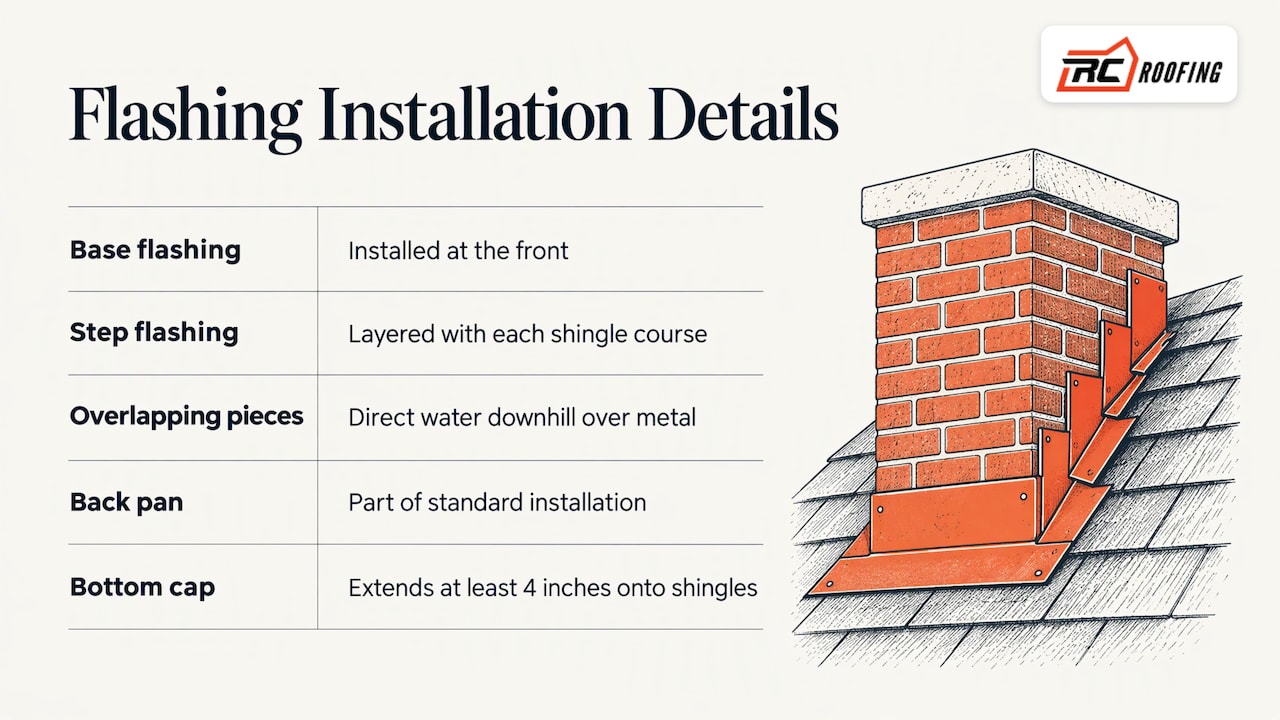
The base flashing goes in at the front, then step flashing is layered with each shingle course up the sides. Each piece overlaps the one below it so water can only run downhill over metal. Fine Homebuilding stresses overlapping pieces and a back pan as part of the standard installation. ASHI’s guidance says the bottom cap flashing should extend at least 4 inches onto the shingles.
4. Set the counterflashing properly
This is the layer most often done badly. Fine Homebuilding recommends securing counterflashing mechanically in a reglet, a groove cut into the mortar joint, instead of relying on caulk alone, and describes details such as copper wedges and riveted corners. A reglet is simply a slot that holds the top edge of the metal tight against the brick. Sealant is a finishing step, not the structure.
5. Add a cricket where the chimney is wide
A cricket is a small peaked roof built behind the chimney. Fine Homebuilding explains that it diverts roof water to the sides so it does not pool against the uphill face of the chimney, and describes overlapping counterflashing sections anchored into reglets. A wide chimney with no cricket collects water and debris, which is hard on the flashing over time.
6. Re-shingle and final check
The shingles go back in around the new metal, and the work is checked from the roof and, where needed, from the attic.
Why caulk and tar are not a lasting fix
A tube of sealant is the instinctive response to a drip, and it can hold for a season. The trouble is that the roof and chimney keep moving, and sealant cracks, shrinks and pulls away. ASHI’s description of caulked and asphalt-cement joints as temporary is the reason we rebuild the layers. Tar also hides the original flashing, which makes the real source of the leak harder to find the next time. If you already see tar around the chimney, that is a sign to have the joint inspected rather than adding more.
The work also happens at height, on a pitched surface next to a masonry stack, with metal edges and brick in the way. For most homeowners the question of whether to climb up there is better answered by our overview of DIY versus professional roof repair.
What affects the price of chimney flashing work
We do not publish set prices for chimney flashing, because the scope decides the cost, and the scope is only clear after someone has looked at the roof. These are the factors that move the quote:
- Repair or full replacement: reworking a few pieces is a smaller job than stripping and rebuilding all four sides.
- Chimney size and number of chimneys: a wide chimney needs more metal and often a cricket.
- Roof pitch and height: steeper or taller roofs take more time and safety equipment.
- Hidden damage: rotted decking or wet insulation adds repair work.
- Masonry condition: reglets, tuckpointing or mortar repair at the counterflashing add labor.
- Material: galvanized steel, aluminum and copper cost different amounts and last different lengths of time.
- Whether it is done with a roof replacement: the flashing is already exposed when the shingles come off.
Ask for a written scope that lists the flashing pieces being replaced, the counterflashing method and any decking work. That is how you compare quotes on equal terms.
Will homeowners insurance cover a chimney leak?
It depends on your policy and on what caused the water to get in. Insurers generally treat sudden storm damage differently from gradual wear, and an inspector’s finding that a flashing leak is long-term can work against a storm claim. Read your policy and talk to your insurance company or agent about your specific claim.
If a storm did damage the roof, we document what we find during an inspection. Our storm damage restoration team handles emergency repairs for storm and hail damage, and the storm damage restoration process guide explains what to expect.
One Missouri rule is worth knowing before you hire anyone. Under RSMo 407.725, a contractor may not advertise or promise to pay or rebate any part of an insurance deductible as an inducement to sell work. That includes discounts or allowances that work as a rebate. If a roofer offers to cover your deductible, treat that as a reason to walk away. We do not make that kind of offer.
Temporary protection while you wait for a repair
If rain is coming and water is already entering, protect the inside first: move belongings and put a bucket under the drip. If the ceiling sags or bulges with water, keep everyone out from under it and away from light fixtures, and call for help. Do not climb onto a wet or icy roof. Our guide on temporary storm roof repair explains what holds and what does not. For active leaks, contact us for an emergency repair.
Chimney flashing repair with RC Roofing and Contracting
We are a family-owned roofing company with a local crew that knows the climate and the mix of older and newer homes in Villa Ridge, Washington and across Franklin County. For a chimney leak, we start with a free inspection of the chimney, the flashing and the roof around it, give you honest advice on repair versus replacement, and stand behind the work with a lifetime workmanship warranty. Our Google rating is 5.0 from more than 275 customers.

If you are in Villa Ridge, start with our chimney flashing page for Villa Ridge. To book an inspection, use our roof inspections page. If the leak is already inside your home, see roof leak repair or our guide on roof leak water damage. We also cover broader chimney repair when the problem extends beyond the flashing.
For property managers and business owners
A leak at a rooftop chimney, flue or similar penetration on a commercial building is handled the same way: find the cause, rebuild the layers and document it. Our commercial roofing work covers inspections and repairs for business properties, and regular inspections catch flashing wear before it reaches tenants. See how often a roof inspection should be scheduled.
Keeping the joint watertight afterward
Once the flashing is sound, a little attention goes a long way:
- Look at the chimney from the ground after storms, using binoculars, for lifted metal or missing shingles.
- Check the ceiling and attic near the chimney each spring and fall. Our seasonal roof repair checklist lays out what to look for.
- Keep gutters and the roof section behind the chimney clear of leaves.
- Have the masonry and crown inspected if you see cracked mortar.
- Plan flashing renewal into any roof replacement.
FAQ
Can a roof leak around the chimney be fixed without replacing the whole roof?
Often, yes. If the shingles are in good condition, the work is limited to the flashing and the roof section around the chimney. If the roof is near the end of its life, replacing the flashing together with the shingles is the longer-lasting choice.
Do roofers repair chimney flashing?
Yes. Flashing is part of the roof system, so a roofer is the right person to repair it. Where the masonry itself is damaged, the repair may also involve the brickwork around the counterflashing. We handle the roof side and can inspect both.
How long does chimney flashing last?
It depends on the material, the installation and the weather. Well-installed metal flashing with properly set counterflashing lasts far longer than caulk or tar, which are temporary. Having it inspected every year or two, and after major storms, is the best way to catch wear early.
Will homeowners insurance pay for chimney flashing repair?
It depends on your policy and on whether the cause was sudden storm damage or long-term wear. Contact your insurer or agent about your claim. In Missouri, a contractor cannot promise to pay or rebate your deductible.
Why does my chimney only leak during heavy rain?
Wind-driven or heavy rain exposes small gaps in the counterflashing, mortar joints or step flashing that light rain does not reach. It is a sign that the joint needs inspection, even if the stain is faint.
Sources
- Chimneys Connected to Roof Structure, Building America Solution Center
- Chimney Flashings, American Society of Home Inspectors
- Chimney Flashing Installation, Family Handyman
- Time-Tested Approach to Chimney Flashing, Fine Homebuilding
- Make a Watertight Chimney Cricket, Fine Homebuilding
- RSMo Section 407.725, Missouri Revisor of Statutes